When the Power Goes Out and the Cloud Stays On: Building a Utility-Resilient Business Continuity Strategy
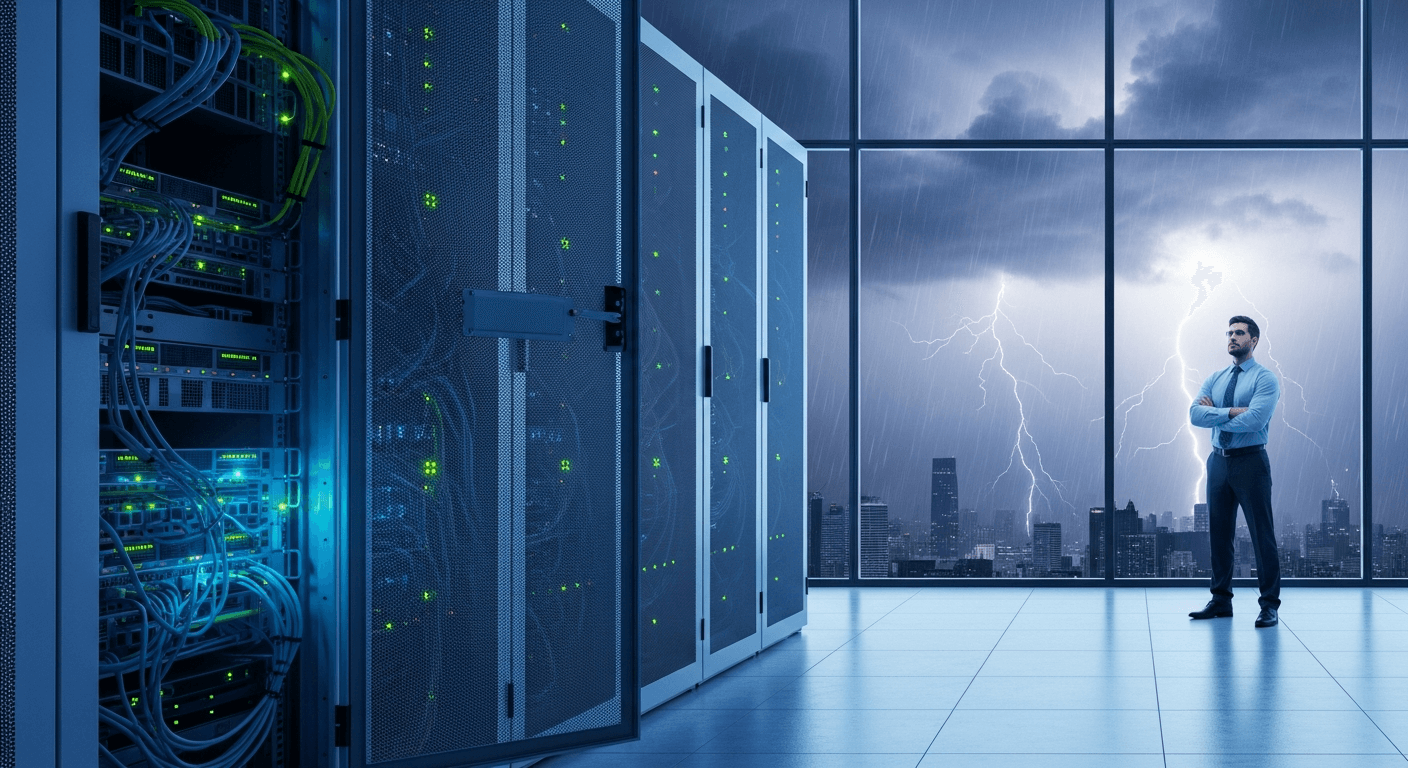
The storm hit on a Tuesday afternoon. By Wednesday morning, 340,000 homes and businesses across the Southeast were without power — some for four days, others for nearly two weeks. The businesses that kept operating weren't lucky. They were prepared.
Physical infrastructure disasters — power outages, flooding, extreme weather events, and utility failures — are no longer rare exceptions that businesses can afford to plan around. They're becoming a predictable, recurring cost of doing business in 2026. And while the cybersecurity community has spent years hardening organizations against ransomware and breaches, the threat of a transformer blowing, a water main rupturing, or a regional grid failure quietly remains one of the most underplanned disaster scenarios in corporate continuity strategies.
This post is about fixing that gap.
Why Physical Utility Failures Are a Growing Business Continuity Threat
The Data Doesn't Lie
The numbers have shifted dramatically over the past several years, and not in a direction that lets businesses breathe easy:
- The U.S. experienced over 180 major weather-related power outages in 2025, according to the Department of Energy's Electric Emergency Incident and Disturbance Report — a figure that has more than tripled over the past decade.
- The average cost of unplanned downtime has climbed to $9,000 to $22,000 per minute for mid-size enterprises, according to Gartner's 2025 infrastructure risk analysis.
- FEMA reported that 40% of small businesses never reopen following a major disaster — a statistic that has remained stubbornly consistent for years because too many businesses still don't have recovery plans that account for physical failures.
- Climate-related business interruption insurance claims rose 63% between 2022 and 2025, driven almost entirely by weather events impacting commercial operations.
What makes utility failures particularly dangerous from a business continuity standpoint is that they tend to cascade. A power outage kills your on-premises servers. Your on-prem servers going dark takes your VoIP phone system with them. Your VoIP going dark means your customer service team can't take calls. And if your internet connectivity runs through on-premises networking equipment that just lost power, your staff can't reach cloud applications either — even if those cloud applications are perfectly healthy.
The "My Cloud Is Fine" Misconception
One of the most common false assumptions we encounter when reviewing business continuity plans is what we call the "my cloud is fine" misconception. Business leaders hear that their data lives in Microsoft Azure or AWS, and they reasonably assume that a local power failure won't affect them. In many cases, that's partially true — their data survives. But their ability to access and use that data may not.
If your on-site network equipment loses power, your staff likely loses access to cloud-hosted applications, communication tools, and collaboration platforms. If your backup internet circuit runs through the same physical infrastructure as your primary circuit, both fail together. If your employees can't get to the office because of flooding, and they don't have a remote work protocol tested and ready, the cloud being healthy doesn't help anyone.
Utility resilience isn't about protecting your data in the cloud. It's about ensuring your entire operational stack — people, connectivity, devices, and data — can keep functioning when your physical environment fails.
The Five Layers of a Utility-Resilient Business Continuity Plan
Layer 1: Power Continuity
This seems obvious, but it's frequently under-engineered. Most businesses have a UPS (uninterruptible power supply) protecting their server room. Fewer have one that's properly sized and load-tested. Fewer still have a generator arrangement that actually covers the workloads they need to maintain during an extended outage.
What to do:
- Conduct a load assessment on your UPS infrastructure annually. What would actually run if the power went out right now, and for how long?
- Identify your Tier 1 systems — the absolute minimum technology needed to keep operations functional — and ensure they're covered by both UPS and generator capacity.
- Establish vendor relationships for emergency generator fuel delivery. A 72-hour generator becomes useless at hour 71 if you haven't pre-arranged resupply.
- Consider edge computing or cloud-first architectures through services like Layer27's Infrastructure Pro, which can reduce your on-premises footprint and therefore the amount of on-site hardware that needs power to keep running.
Layer 2: Connectivity Redundancy
Your internet connection is the lifeline between your staff and everything they need to do their jobs in a cloud-first world. A single ISP connection — no matter how fast or reliable under normal conditions — is a single point of failure.
What to do:
- Implement dual-ISP configurations using providers that run on physically separate infrastructure. Fiber from Provider A and LTE/5G from Provider B is a common and cost-effective pairing.
- Configure automatic failover on your routing equipment so connectivity switches without manual intervention.
- For organizations with remote or hybrid workforces, verify that employees working from home also have connectivity backup options — a business-grade mobile hotspot policy is inexpensive insurance.
- Review SD-WAN capabilities as part of your network design. Modern SD-WAN solutions can intelligently route traffic across multiple ISPs in real time, prioritizing latency-sensitive applications automatically.
Layer 3: Workload and Data Resilience in the Cloud
Once your people have power and connectivity, the question becomes: can they reach the systems they need, and is the data safe?
This is where cloud architecture decisions made months or years ago either pay off or expose gaps.
What to do:
- Ensure your production workloads are hosted in a cloud environment with geographic redundancy — not just a single availability zone in a single region. Layer27's Cloud Services practice, including both Public Cloud and Private Cloud options, helps organizations architect workloads that can survive regional disruptions.
- For businesses with mixed environments — some applications on-premises, others in the cloud — a Hybrid Cloud strategy with well-defined failover paths gives you the best of both worlds without creating blind spots.
- Implement Backup-as-a-Service (BaaS) with off-site replication. Backups stored only on-premises fail along with everything else when the building floods. BaaS solutions ensure copies of your critical data exist in geographically separate, independently powered locations.
- Test your backups. A backup that hasn't been restored in a test environment is a backup that may not work when you actually need it. Regular restore testing should be a documented, recurring procedure — not a theoretical plan.
Layer 4: Disaster Recovery That Actually Activates
There's a meaningful difference between having a disaster recovery plan and having a disaster recovery capability. A plan is a document. A capability is a tested, operational set of systems and procedures that your team can execute under pressure, at 2 a.m., when the situation is stressful and half the key people are unreachable.
Disaster Recovery-as-a-Service (DRaaS) bridges that gap by moving recovery infrastructure from a theoretical document to an always-ready, cloud-hosted environment that can be activated quickly.
With Layer27's DRaaS, organizations can define Recovery Time Objectives (RTOs) and Recovery Point Objectives (RPOs) that reflect actual business needs — and then build and test recovery systems that are capable of meeting them. The most common failure mode in disaster recovery isn't a lack of planning. It's discovering during an actual event that your RTO was 4 hours but your actual recovery capability takes 14 hours.
What to do:
- Define your RTO and RPO for each critical system — not just as numbers in a document, but as targets that your team has actually validated through tabletop exercises and live failover tests.
- Conduct at least two full DR tests per year, including one unannounced "game day" exercise that simulates a real event.
- Document not just the technical recovery steps, but the human decision tree: who declares a disaster, who has authority to activate recovery systems, who communicates to customers, and who handles vendor coordination.
- Ensure your DR plan accounts for utility failure scenarios specifically — not just ransomware or hardware failure, which are the scenarios most plans are written around.
Layer 5: People and Process Continuity
Technology can be redundant, backed up, and geographically distributed — and still fail to keep a business operational if the human side of continuity isn't addressed.
What to do:
- Maintain an up-to-date emergency contact tree that includes personal cell phones, not just work email addresses that may be inaccessible.
- Establish clear remote work activation protocols so that if employees can't get to the office, they know exactly what to do, where to go (logically), and what tools to use.
- Cross-train employees on critical processes so that a key person being unreachable doesn't create a single point of human failure.
- Communicate proactively with customers and vendors during disruption events. A 15-minute investment in a prepared customer communication template can protect years of relationship equity.
The Role of Monitoring and Early Warning
One aspect of utility resilience that often gets overlooked is the value of early detection and alerting. By the time a power failure has knocked your systems offline, you're already in reactive mode. Infrastructure monitoring that provides advance warning — a UPS battery degrading, a network link experiencing instability, a cooling system throwing error codes — gives your team the opportunity to act before a disruption becomes a disaster.
Layer27's 24x7 SOC provides around-the-clock infrastructure and security monitoring, alerting your team (and ours) to anomalies before they cascade into outages. This kind of proactive visibility is particularly valuable for businesses that don't have internal IT staff monitoring systems overnight and on weekends — which is exactly when utility events tend to occur.
For organizations looking for a comprehensive starting point, Layer27's Safe Start and Protect Pro packages are designed to layer security, monitoring, and backup capabilities in a way that addresses both cyber threats and physical infrastructure risks in a single, coordinated program.
Common Mistakes Businesses Make (and How to Avoid Them)
Treating DR as a One-Time Project
Business continuity planning isn't a project with a completion date. Your technology environment changes. Your team changes. Your vendors change. Your risk profile changes. Treat your continuity plan as a living document with scheduled review cycles — at minimum annually, and any time a major change occurs to your infrastructure or operations.
Writing Plans That Only IT Can Execute
If your disaster recovery plan requires deep technical knowledge to execute and only two people in the organization have that knowledge, your plan has a critical dependency. Build runbooks and procedures that a competent non-specialist can follow, and ensure key recovery steps are documented clearly enough to be executed by someone who wasn't in the room when the plan was written.
Underestimating Interdependencies
Modern business operations involve dozens of interconnected systems — ERP, CRM, VoIP, payment processing, email, video conferencing, identity providers. When you're mapping out what needs to survive a utility disruption, trace the dependency chains. A system that seems peripheral may be the authentication source for five others.
Not Involving Business Stakeholders
IT shouldn't be writing business continuity plans in isolation. The finance team knows which payment deadlines can't be missed. Operations knows which production steps can be paused and which can't. Sales leadership knows which customer commitments have contractual implications. A technically sound DR plan that doesn't reflect business priorities is still an incomplete plan.
Getting Started: A Practical 30-Day Assessment Framework
If you're not sure where your organization stands, here's a practical framework to get oriented quickly:
Week 1 — Inventory and Dependency Mapping Document every critical system, its physical location, its power dependencies, its connectivity dependencies, and its cloud or on-premises hosting status.
Week 2 — Gap Analysis For each critical system, ask: "If the power goes out for 72 hours, what happens to this system, and what's the recovery path?" Document the gaps honestly.
Week 3 — RTO/RPO Definition Work with business stakeholders to define recovery time and recovery point objectives for each critical system. These should reflect business impact, not just technical convenience.
Week 4 — Quick Wins and Roadmap Identify the two or three changes that would have the highest impact on your resilience posture with the lowest effort or cost — and make a prioritized roadmap for the rest.
For organizations that want help running this assessment, Layer27's Co-Managed IT service can work alongside your internal team to conduct the analysis, fill gaps in technical expertise, and develop a realistic, prioritized improvement roadmap.
Conclusion: Resilience Is a Business Strategy, Not an IT Project
The businesses that navigate utility failures, weather disasters, and infrastructure disruptions without catastrophic loss aren't just lucky — they've made deliberate investments in resilience. They've tested their recovery plans before they needed them. They've built redundancy into their power, connectivity, and cloud architecture. And they've made sure that the humans executing the plan know exactly what to do when the lights go out.
In 2026, with climate-driven disruptions accelerating and operational downtime costs continuing to climb, utility-resilient business continuity isn't a nice-to-have. It's a competitive differentiator — and for some businesses, it's the difference between surviving a disaster and becoming a statistic.
Layer27 helps organizations across the United States build continuity strategies that are tested, realistic, and built for the threats they actually face — including the ones that don't come with a phishing email. From Backup-as-a-Service and DRaaS to Infrastructure Pro and 24x7 SOC monitoring, we provide the layered capabilities that keep businesses operational when everything else goes sideways.
Ready to find out where your continuity plan stands? Our team will help you identify gaps, prioritize improvements, and build a resilience strategy that matches your business's real risk profile.